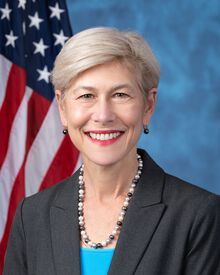
Deborah Ross is the Democratic U.S. representative for North Carolina's 2nd Congressional District, which includes most of Wake County, and is seeking re-election. A civil rights and clean energy attorney, she served in the North Carolina House from 2003 to 2013, was the Democratic nominee for U.S. Senate in 2016, and has represented the district in Congress since 2021. She serves on the House Judiciary, Ethics, and Science, Space, and Technology committees.[1][2]
Deborah Ross was born in Philadelphia, Pennsylvania, in 1963.[1][2] According to her official House biography, she grew up in a small town as the daughter of an Air Force veteran and an early childhood education teacher.[2] She earned a bachelor's degree in international relations from Brown University in 1985 and a law degree from the University of North Carolina Law School in 1990.[1][2] She worked as a civil rights lawyer before holding public office, and her official biography says she helped pass the South's first anti-racial profiling law and reforms to the state's juvenile justice laws. She later worked in private practice on North Carolina's clean energy sector.[2]
Ross won a seat representing Wake County in the North Carolina House of Representatives in 2002 and served from 2003 to 2013 (District 34), including on the Education, Elections, Ethics, Finance and Judiciary committees.[1][2] She was the Democratic nominee for U.S. Senate in 2016, losing the general election to incumbent Republican Richard Burr.[1] In November 2020 she won the open 2nd Congressional District seat, succeeding Republican George E.B. Holding, and she was re-elected in 2022 and 2024.[1]
In the 119th Congress (2025-2026), Ross serves on the House Judiciary Committee, the Ethics Committee, and the Science, Space, and Technology Committee, and is a Chief Deputy Whip and a member of the Steering and Policy Committee for House Democrats.[1][2] Her official biography states that 17 pieces of her legislation have been signed into law, including bills on funding for sexual assault nurse examiners, accountability for perpetrators of child sexual abuse, judicial ethics and transparency, and North Carolina's offshore wind energy potential.[2]
Researched from the cited sources on 2026-10-21.