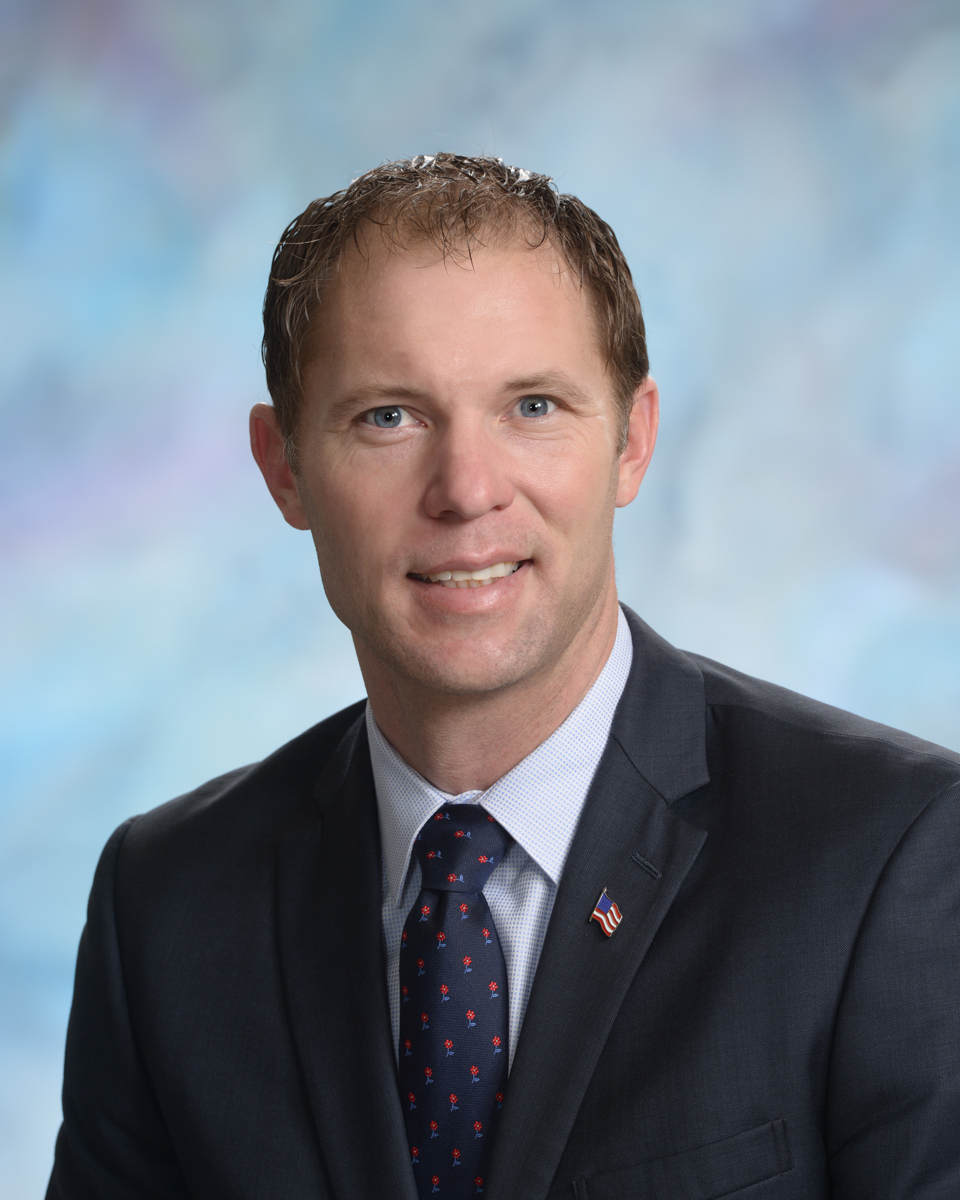
Chris Kassin is a Republican state representative who has represented South Dakota House District 17 since 2023 and is seeking re-election on November 3, 2026.[1][2][2]A higher-education development and athletics administrator, he faces Republican Troy Redler and Democrats Austin Brunick and Leslie Gerrish for the district's two seats, according to Ballotpedia.[1][2]
Chris Kassin graduated from Huron High School and earned a B.S. in criminal justice and corrections in 2002 and an M.P.A. in 2005, both from the University of South Dakota, according to Ballotpedia.[1]Ballotpedia lists his career experience as vice president of external relations of the University of South Dakota Foundation, vice president for strategy and athletic director of Mount Marty University, and assistant athletic director at the University of South Dakota.[1]
Kassin took office on January 10, 2023, and for 2025-2026 Ballotpedia lists his committee assignment as House Appropriations.[1]In a 2022 Ballotpedia survey, he said he had lived in Vermillion for more than 20 years, supports low taxes and regulation and a pro-business climate, and named a strong economy, great schools and quality health care as policy priorities.[1]
Their recorded votes on bills that divided the chamber (unanimous votes left out), grouped by topic. A bill can sit under more than one topic. "With" and "against" compare each vote with how most Republicans voted. How topics are assigned
Adds cultivated-protein food products, defined as foods resembling animal tissue made by growing animal cells in vitro, to the foods deemed adulterated under South Dakota food law.
Mar 30, 2026 · Failed 32–32 · against most RepublicansOfficial record ↗
On the version voted Feb 10, 2026: Lets municipalities impose a temporary gross receipts tax of up to 1 percent for capital projects, if a five-member capital improvement board approves and 60 percent of voters voting approve; revenue goes to a special capital outlay fund.
On the version voted Mar 9, 2026: Requires employers with more than 50 employees to verify new hires through E-Verify within 20 days, and lets the attorney general seek a $2,000 civil penalty per violation when federal agencies confirm knowing employment of an unauthorized worker.
Feb 12, 2026 · Passed 49–13 · with most RepublicansOfficial record ↗
Requires the secretary of state to post the complete statewide voter registration file and a rolling five-year historical archive on its website before 11:59 p.m. central time each Monday.
Mar 3, 2026 · Passed 36–30 · against most RepublicansOfficial record ↗
Raises the penalty for using threat or violence to intentionally prevent another person from performing a lawful religious act from a Class 1 misdemeanor to a Class 6 felony.
Feb 26, 2026 · Passed 48–18 · with most RepublicansOfficial record ↗
Adds cultivated-protein food products, defined as foods resembling animal tissue made by growing animal cells in vitro, to the foods deemed adulterated under South Dakota food law.
Mar 30, 2026 · Failed 32–32 · against most RepublicansOfficial record ↗
Repeals the legislative oversight committee on the state's medical marijuana program, including its membership, chair rules, and its duty to meet twice a year and make recommendations.
Feb 23, 2026 · Passed 41–26 · with most RepublicansOfficial record ↗
On the version voted Mar 10, 2026: Requires nicotine product distributors to hold a Department of Revenue license ($1,000 fee), limits retailers to buying from licensed distributors, sets age-21 verification for direct shipments to consumers, and makes unlicensed sales a Class 1 misdemeanor.
Feb 19, 2026 · Passed 40–25 · with most RepublicansOfficial record ↗
Repeals state licensing of hemp growers, researchers and processors, so that only producers licensed by the USDA or a tribal program may grow hemp in South Dakota, effective January 1, 2027.
On the version voted Mar 3, 2026: Allows salvage of eggs of certain protected birds by people holding a federal migratory bird special purpose salvage permit, except eggs of birds whose taking is always prohibited.
Feb 11, 2026 · Passed 54–11 · with most RepublicansOfficial record ↗
As amended, requires school districts to use Board of Education Standards-recommended prenatal development resources in health or science classes, including an ultrasound video and an animation or ultrasound video of 3+ minutes, and bars materials from entities that perform, promote, or regularly refer to abortion.
Feb 12, 2026 · Passed 52–10 · with most RepublicansOfficial record ↗
Rewrites the list of allowed uses of a school district's capital outlay fund as a numbered list and adds payment of the district's property insurance premiums.
Jan 29, 2026 · Passed 41–25 · with most RepublicansOfficial record ↗
As amended, bars student cell phone use during the school day, except for administrator-approved health care, Section 504 plans or IEPs, teacher-permitted lessons and emergencies; requires school boards to adopt discipline policies for violations.
Lets the attorney general, with approval from a Hughes County judge, issue investigative subpoenas to electronic and internet providers for subscriber and account records in Division of Criminal Investigation cases on internet crimes against children or human trafficking.
Makes it a Class 5 felony to knowingly create or share digitally fabricated nude or sexual depictions of an identifiable person, without consent and with intent to self-gratify, harass or harm; also revises the existing invasion-of-privacy offense.
On the version voted Feb 25, 2026: Appropriates $87 million in federal fund spending authority to the Governor's Office of Economic Development for broadband infrastructure grants under the federal BEAD program.
Feb 26, 2026 · Passed 55–11 · with most RepublicansOfficial record ↗
Adds English language proficiency to the requirements for a South Dakota commercial driver license and updates the referenced federal testing and entry-level driver training standards to their January 1, 2026 versions.
Lets the state housing authority make loans from the housing infrastructure fund of up to $15 million each to airports with scheduled air service in metropolitan areas of at least 125,000 residents, for airport infrastructure.
On the version voted Mar 2, 2026: Lets highway patrol, transportation department, sheriff and peace officers arrange removal of disabled vehicles and spilled cargo, makes the owner liable for costs, and shields them from damages absent gross negligence or willful misconduct.
Feb 10, 2026 · Passed 53–13 · with most RepublicansOfficial record ↗
Lets the state housing authority make loans from the housing infrastructure fund of up to $15 million each to airports with scheduled air service in metropolitan areas of at least 125,000 residents, for airport infrastructure.
Allows counties, by ordinance, to impose a gross receipts tax of up to one-half percent on sales taxable under the state sales tax, with proceeds credited against county property taxes, starting with owner-occupied property.
Lets the attorney general fine up to 10 percent of a land interest's value for not filing with the state a copy of a federal foreign-ownership report; subjects a violating minority owner's inherited farmland share to forfeiture plus an equal-value penalty.
Appropriates $8 million from the general fund to the South Dakota Ellsworth Development Authority for roadway and related infrastructure improvements needed because of construction on Ellsworth Air Force Base, with administrative costs capped at 3 percent.
Voted against most of their party on 3 of 18 party-divided votes on file.
consider a cultivated-protein food product to be adulterated food.
A yes vote was to override the governor's veto of HB 1077, which would classify cultivated-protein food products as adulterated food. (AI-written)
What it does: Adds cultivated-protein food products, defined as foods resembling animal tissue made by growing animal cells in vitro, to the foods deemed adulterated under South Dakota food law.
Voted no · most Republicans voted yes · Democrats 0–5, Republicans 32–27
amend provisions pertaining to the publication of the statewide voter registration file.
What it does: Requires the secretary of state to post the complete statewide voter registration file and a rolling five-year historical archive on its website before 11:59 p.m. central time each Monday.
Voted no · most Republicans voted yes · Democrats 0–5, Republicans 36–25
consider a cultivated-protein food product to be adulterated food.
What it does: On the version voted Mar 30, 2026: Adds cultivated-protein food products, defined as foods resembling animal tissue made by growing animal cells in vitro, to the foods deemed adulterated under South Dakota food law.
Voted no · most Republicans voted yes · Democrats 1–4, Republicans 44–18
Substantive votes concern legislation or nominations; procedural votes concern how the chamber considers them. A Yes vote applies to the motion shown, which may not be final passage.
HB 1077 · SD HOUSE
consider a cultivated-protein food product to be adulterated food.
NoVOTED
Motion: Veto override
A yes vote was to override the governor's veto of HB 1077, which would classify cultivated-protein food products as adulterated food. (AI-written)
Adds cultivated-protein food products, defined as foods resembling animal tissue made by growing animal cells in vitro, to the foods deemed adulterated under South Dakota food law.
transfer moneys and make an appropriation for the replacement of the Richmond Lake dam and spillway and to declare an emergency.
YesVOTED
Motion: Conference Committee Report adopted
A yes vote adopted the conference committee report on SB 121, setting the transfer and appropriation for replacing the Richmond Lake dam and spillway at $8,212,497. (AI-written)
Transfers $8.2 million from the unclaimed property trust fund to the general fund and appropriates the same amount to replace the Richmond Lake dam and spillway.
appropriate money for the ordinary expenses of the legislative, judicial, and executive departments of the state, the current expenses of state institutions, interest on the public debt, and common schools.
YesVOTED
Motion: Do Pass
On the version voted Mar 11, 2026: Appropriates money for the fiscal year ending June 30, 2027, for the ordinary expenses of state government's legislative, judicial and executive departments, state institutions, interest on the public debt, and common schools, with amounts set by budget unit.
revise property tax levies for school districts and to revise the state aid to general and special education formulas.
YesVOTED
Motion: Do Pass Amended
Sets school district general fund property tax levy caps for taxes payable in 2027 and later, including $4.867 per thousand dollars of valuation generally, and revises state aid for general and special education.
revise the General Appropriations Act for fiscal year 2026.
YesVOTED
Motion: Do Pass Amended
On the version voted Mar 11, 2026: Changes dollar amounts in the fiscal year 2026 General Appropriations Act for operating budgets of numerous state agencies and funds.
make an appropriation for victim services provided by nonprofit organizations.
YesVOTED
Motion: Conference Committee Report adopted
A yes vote adopted the conference committee report on HB 1200, setting the appropriation for victim-services grants at $5,500,000. (AI-written)
On the version voted Feb 26, 2026: Appropriates general fund money to the Department of Public Safety for grants to nonprofits assisting abused or neglected children and victims of domestic violence, sexual assault or trafficking, for services such as emergency lodging, licensed counseling, crisis lines and child advocacy centers.
prohibit the dispensing, distribution, sale, or advertisement of certain articles or things for purposes of an unlawful abortion and provide a criminal and civil penalty therefor.
YesVOTED
Motion: Concurred in amendments
A yes vote accepted the Senate's amendment to HB 1274, which revises SDCL 22-17-5.1, the Class 6 felony for administering or procuring an abortion, to cover "any person" instead of "any pregnant female". (AI-written)
Makes it a Class 6 felony to knowingly dispense, distribute, sell or advertise items for an unlawful abortion, and lets the attorney general seek civil penalties up to $10,000 per violation, plus injunctions.
modify the requirements to refer an ordinance or resolution to the voters of a political subdivision.
YesVOTED
Motion: Failed to concur, no committee appointed
A yes vote rejected the Senate's amendments to HB 1323, which shorten the petition filing period to 20 days and cap required signatures at 2,500 registered voters, without appointing a conference committee. (AI-written)
As amended, changes how voters refer county, municipal and school district decisions to a public vote: petitions need signatures of 5 percent of registered voters or 2,500, whichever is fewer, and certain county and municipal decisions cannot be referred.
authorize counties and municipalities to issue a license for a cigar bar.
YesVOTED
Motion: Concurred in amendments
A yes vote accepted the Senate's amendment to the cigar-bar licensing bill, which drops the limits on the number of licenses and the cigar ring-gauge and filter definition, and replaces annual reporting to Revenue with keeping three years of records. (AI-written)
Lets counties and municipalities license cigar bars on the premises of certain alcohol-licensed establishments that have a humidor, enclosed ventilated space, and at least 10 percent of income from cigars, and allows only cigars to be smoked there.
regulate the sale of nicotine products, and to provide a penalty therefor.
YesVOTED
Motion: Concurred in amendments
A yes vote accepted the Senate's amendments to HB 1220, which set conditions for shipping alternative nicotine products to consumers (age-21 signature, labeled packages, buyer records, tax remittance, audits) and make resale of shipped products a Class 1 misdemeanor. (AI-written)
Requires nicotine product distributors to hold a Department of Revenue license ($1,000 fee), limits retailers to buying from licensed distributors, sets age-21 verification for direct shipments to consumers, and makes unlicensed sales a Class 1 misdemeanor.