HB 5356 · MI SENATE
Michigan vehicle code: amend sections 14, 41a, 78, 217, 217c, 233, 233a, 233b, 234, 235, 238, 239, 240, 248, 248a, 248f, 248j, 249, 250, 258, 801b, 806, and 810a
Motion: Third reading and passage
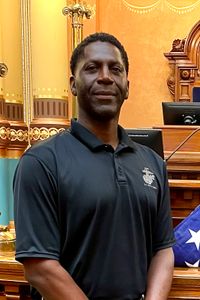 Photo: s3.amazonaws.com
MI · Officeholder
DState Senator · District 35
On the ballot Nov 3, 2026: Michigan Senate District 35
Chedrick Greene is the Democratic state senator for Michigan's District 35, who won a May 5, 2026 special general election and is on the November 3, 2026 ballot seeking a full term.[1][2] A U.S. Marine Corps veteran and Saginaw fire captain, he said in a Ballotpedia survey that his priorities include making life more affordable and bringing better-paying jobs to the region.[1][3]
Chedrick Greene was born in Saginaw, Michigan, and graduated from Bridgeport High School in 1993.[1] He served in the U.S. Marine Corps from 1994 to 2024.[1] His career experience includes working as a fire captain with the City of Saginaw Fire Department and as a district assistant to former state Senator Kristen McDonald Rivet.[1]
Greene won the Democratic primary in February 2026 and the special general election on May 5, 2026, defeating Republican Jason Tunney and Libertarian Ali Sledz, and he took office on May 21, 2026, succeeding McDonald Rivet.[1] He advanced from the August 4, 2026 Democratic primary and faces Tunney and Laurie Atwood of the U.S. Taxpayers Party in the general election.[1]
In a Ballotpedia survey, Greene described himself as a 30-year Marine veteran, 26-plus-year firefighter and 31-plus-year union member and said he is passionate about pro-labor and pro-working-family policies.[3] He said his top priority is to make life more affordable and the region more attractive for better-paying jobs, and that he would work to expand education and skills training.[3]
Researched from the cited sources on 2026-10-21. Not yet independently fact-checked.
Chedrick Greene is on the Nov 3, 2026 ballot for Michigan Senate District 35 as D. Not researched in depth — candidate list only.
Their recorded votes on bills that divided the chamber (unanimous votes left out), grouped by topic. A bill can sit under more than one topic. "With" and "against" compare each vote with how most Democrats voted. How topics are assigned
Most contested
Create the secure retirement savings board and prescribe its powers and duties.
Creates the Secure Retirement Savings Board within the Department of Treasury and sets its membership and appointment terms; the board would administer the automatic-enrollment retirement savings program proposed in Senate Bill 807.
Jun 17, 2026 · Passed 20–18 · with most DemocratsOfficial record ↗
Creates a state-run automatic-enrollment payroll-deduction IRA program in the Department of Treasury for private-sector employees whose employers have not offered a qualified retirement plan in the prior two years; employees can opt out, and employers may set up their own plan instead.
Jun 17, 2026 · Passed 20–18 · with most DemocratsOfficial record ↗
Recodified tax increment financing act: amend sections 201, 301, 402, 523, 603, 703, and 803
Excludes the property tax levied by county history museum authorities from tax increment revenues that tax increment financing authorities may capture.
Sep 10, 2026 · Passed 20–15 · with most DemocratsOfficial record ↗
Most contested
Michigan election law: amend sections 726, 736, and 751
Requires local governments to notify the Secretary of State of changes to election methods, voter-removal programs and certain records requests, and lets voters unable to enter a polling place or early voting site request voting assistance from the clerk or precinct board.
Jun 16, 2026 · Passed 20–17 · with most DemocratsOfficial record ↗
Requires local governments to provide election language assistance when thresholds are met, such as, before 2030, over 5% of voting-eligible residents speaking one non-English language with limited English proficiency; the Secretary of State reimburses certain ballot-tabulation costs.
Jun 16, 2026 · Passed 20–17 · with most DemocratsOfficial record ↗
Requires the Secretary of State to contract with public universities by Nov. 5, 2027 to create a Voting and Elections Database and Institute for election research and training, with free access to at least 12 years of election data.
Jun 16, 2026 · Passed 20–17 · with most DemocratsOfficial record ↗
Most contested
The insurance code of 1956: amend section 3406o
Repeals the Insurance Code section that lets insurers provide coverage for emergency and early prescription refills that meet specified requirements.
Jun 18, 2026 · Passed 20–16 · with most DemocratsOfficial record ↗
The insurance code of 1956: add section 3406nn.
Requires the Department of Insurance and Financial Services to apply for a state waiver to set up a state-based health reinsurance program and to report to the appropriations committees on the money needed to fund it.
Jun 18, 2026 · Passed 20–16 · with most DemocratsOfficial record ↗
The insurance code of 1956: amend section 2212a
Requires health insurers, at enrollment, to provide information required by the state health insurance exchange created in Senate Bill 973, as directed by the Department of Insurance and Financial Services.
Jun 18, 2026 · Passed 20–16 · with most DemocratsOfficial record ↗
Most contested
The revised school code: amend section 1351a
Changes what school districts may buy with borrowed money, notes or bonds for technology: bars consumables, out-of-warranty device repairs, and curriculum-specific software or training, replacing the current list of barred uses.
Jun 24, 2026 · Passed 22–15 · with most DemocratsOfficial record ↗
Writes the Tri-Share Child Care program into law under the Department of Lifelong Education, Advancement, and Potential, letting employers take part by covering at least one-third of an employee's child care costs, creates a dedicated fund, and codifies the CareShare arrangement without state subsidy.
Jul 3, 2026 · Passed 23–13 · with most DemocratsOfficial record ↗
Open meetings act: amend section 3a
Allows the Children Trust Michigan state board to meet electronically in any circumstances, without the limit confining remote participation to members absent for military duty or a medical condition; takes effect only if SB 418, SB 421, and HB 4805 are enacted.
Jul 3, 2026 · Passed 22–14 · with most DemocratsOfficial record ↗
Most contested
The insurance code of 1956: amend sections 476a and 476b
Lets out-of-state insurers subtract the new housing opportunity tax credit they claim from the burden counted in Michigan's insurer retaliatory tax calculation, starting in 2027.
Jul 3, 2026 · Passed 21–15 · with most DemocratsOfficial record ↗
Income tax act of 1967: add sections 281 and 678.
Allows a qualified taxpayer to claim the nonrefundable Housing Opportunity Tax Credit, as allocated on an eligibility certificate, against individual or corporate income tax starting January 1, 2027, under the MSHDA program created in HB 5805.
Jul 3, 2026 · Passed 21–15 · with most DemocratsOfficial record ↗
State housing development authority act of 1966: amend section 22
Lets the Michigan State Housing Development Authority run a housing opportunity tax credit program for low-income housing projects, capped at $42 million a year from 2027 and adjusted for inflation; each credit is the lesser of the federal credit or one-sixth of the reserved amount.
Jul 3, 2026 · Passed 22–14 · with most DemocratsOfficial record ↗
Most contested
Bars businesses in the energy products and services chain of distribution from charging grossly higher prices than for similar products during a market disruption; allows attorney general suits and civil and criminal penalties.
Jun 25, 2026 · Passed 20–15 · with most DemocratsOfficial record ↗
Revises the dam safety law: extends state oversight to federally licensed dams, changes spillway capacity criteria and increases inspection frequency for high- and significant-hazard dams, creates 10-year dam registrations, and allows emergency orders to remove dams in imminent danger of failure.
Jul 2, 2026 · Passed 22–15 · with most DemocratsOfficial record ↗
Jun 17, 2026 · Passed 29–9 · with most DemocratsOfficial record ↗
Most contested
Oct 14, 2026 · Passed 31–3 · with most DemocratsOfficial record ↗
Michigan vehicle code: amend section 657a
Jul 3, 2026 · Passed 33–3 · against most DemocratsOfficial record ↗
Most contested
Jul 3, 2026 · Passed 33–3 · with most DemocratsOfficial record ↗
Voted with most of their party on all 65 party-divided votes on file.
The votes in their chamber that came out closest and most divided by party, among those they voted on. How we rank
Create the secure retirement savings board and prescribe its powers and duties.
With most of their party · Passed 20–18 · Yes 20–No 18 · Democrats 20–0, Republicans 0–18
Jun 17, 2026Official record ↗
With most of their party · Passed 20–18 · Yes 20–No 18 · Democrats 20–0, Republicans 0–18
Jun 17, 2026Official record ↗
Michigan election law: amend sections 726, 736, and 751
With most of their party · Passed 20–17 · Yes 20–No 17 · Democrats 20–0, Republicans 0–17
Jun 16, 2026Official record ↗
With most of their party · Passed 20–17 · Yes 20–No 17 · Democrats 20–0, Republicans 0–17
Jun 16, 2026Official record ↗
With most of their party · Passed 20–17 · Yes 20–No 17 · Democrats 20–0, Republicans 0–17
Jun 16, 2026Official record ↗
With most of their party · Passed 20–17 · Yes 20–No 17 · Democrats 20–0, Republicans 0–17
Jun 16, 2026Official record ↗
The insurance code of 1956: amend section 3406o
With most of their party · Passed 20–16 · Yes 20–No 16 · Democrats 20–0, Republicans 0–16
Jun 18, 2026Official record ↗
The insurance code of 1956: add section 3406nn.
With most of their party · Passed 20–16 · Yes 20–No 16 · Democrats 20–0, Republicans 0–16
Jun 18, 2026Official record ↗
Substantive votes concern legislation or nominations; procedural votes concern how the chamber considers them. A Yes vote applies to the motion shown, which may not be final passage.
Motion: Third reading and passage
Motion: Concur in substitute made by the House
On the version voted Jul 2, 2026: Revises the dam safety law: extends state oversight to federally licensed dams, changes spillway capacity criteria and increases inspection frequency for high- and significant-hazard dams, creates 10-year dam registrations, and allows emergency orders to remove dams in imminent danger of failure.
Motion: Third reading and passage
Motion: Third reading and passage
Motion: Third reading and passage
Motion: Third reading and passage
Motion: Third reading and passage
Motion: Third reading and passage
Excludes the property tax levied by county history museum authorities from tax increment revenues that tax increment financing authorities may capture.
Motion: Third reading and passage
Excludes the property tax levied by county history museum authorities from tax increment revenues that brownfield redevelopment authorities may capture.
Motion: Third reading and passage
Creates the History Museum Authorities Act, letting any county form an authority that, with voter approval, may levy up to 0.2 mill for up to 10 years to fund a history museum owned by a city of over 500,000 people.
Showing 10 of 107 votes in this collection. Coverage may be incomplete; each entry links to the official record.