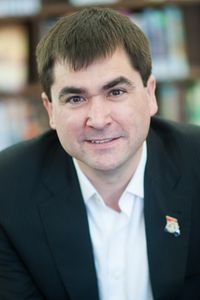
Mark Boyko is a Democratic state representative from Missouri House of Representatives District 90, an office he has held since January 2025, and is running for re-election in the November 3, 2026 general election.[1]An attorney, he earned his law degree from the University of Missouri, Columbia in 2004.[1]
Mark Boyko was born in Fort Knox, Kentucky, and earned a bachelor's degree from the University of Illinois, Urbana-Champaign in 2001 and a law degree from the University of Missouri, Columbia in 2004; he also studied at New York University School of Law in 2005.[1]Ballotpedia says his career experience includes working as an attorney at law and that, as of 2024, he was affiliated with the St. Louis Area Diaper Bank and the Friends of Kathy J. Weinman Shelter for Victims of Domestic Violence.[1]
Boyko assumed office on January 8, 2025, succeeding Barbara Phifer, and advanced from the August 4, 2026 Democratic primary.[1]His 2025-2026 committee assignments are the Elementary and Secondary Education Committee, the Legislative Review Committee and the Joint Committee on Legislative Research.[1]
Their recorded votes on bills that divided the chamber (unanimous votes left out), grouped by topic. A bill can sit under more than one topic. "With" and "against" compare each vote with how most Democrats voted. How topics are assigned
›Jobs & cost of living264 with · 4 against268 votes
Appropriates money for the expenses, grants, refunds, and distributions of the Department of Mental Health, the Department of Health and Senior Services, and the Missouri Health Facilities Review Committee
Submits to voters an amendment creating the Show-Me Prosperity Fund, invested in S&P 500 index funds. Once its earnings can replace the revenue, appropriations capped at 3% of its five-year average value may be used solely to eliminate state income, sales, corporate and other taxes.
Moves school board elections in districts mostly in counties of 400,000 to 500,000 people to November of even-numbered years from 2028 with four-year terms, lets candidates choose to list a party, and puts school tax and bond proposals on those ballots.
On the version voted May 15, 2026: Makes two parts of the bill take effect immediately: authority for certified peace officers to mitigate credible drone threats, and a revised drone offense over open-air venues (now 500-person capacity, was 5,000) and critical infrastructure.
Moves school board elections in districts mostly in counties of 400,000 to 500,000 people to November of even-numbered years from 2028 with four-year terms, lets candidates choose to list a party, and puts school tax and bond proposals on those ballots.
Appropriates money for the expenses, grants, refunds, and distributions of the Department of Mental Health, the Department of Health and Senior Services, and the Missouri Health Facilities Review Committee
Directs the POST commission to create a Missouri Rangers training program of up to 160 hours with a fitness test; rangers employed by schools get limited arrest powers on school property and may carry firearms if the school authorizes.
On the version voted May 15, 2026: Raises the uniform speed limit on rural interstates and freeways from 70 to 75 miles per hour and raises the maximum limit the state may set on state roads to 75.
Creates provisions restricting political subdivisions from imposing requirements that threaten affordability of developments or improvements of property
On the version voted May 15, 2026: Makes two parts of the bill take effect immediately: authority for certified peace officers to mitigate credible drone threats, and a revised drone offense over open-air venues (now 500-person capacity, was 5,000) and critical infrastructure.
Substantive votes concern legislation or nominations; procedural votes concern how the chamber considers them. A Yes vote applies to the motion shown, which may not be final passage.
HB 2017 · MO HOUSE
Appropriations bill
YesVOTED
Motion: Previous question
A yes vote would have ended debate and forced an immediate vote on House Resolution 2, which informed the Senate that the House adopted no motions to override the Governor's vetoes of HB 2002-2012 and HB 2017. (AI-written)
A yes vote adopted the Senate's version of HB 1696, which changes who is next-of-kin for the right of sepulcher and requires criminal background checks for residential camp staff and volunteers. (AI-written)
Modifies provisions relating to the right of sepulcher
A yes vote ended debate on the Senate's version of HB 1696 (right of sepulcher and camp staff background checks) so the House could vote on adopting it (previous question). (AI-written)
Modifies provisions relating to the right of sepulcher
A yes vote adopted the Senate's version of HB 2474, which adds progressive design-build contracts to public contract law and authorizes more cooperative purchasing agreements by the state. (AI-written)
A yes vote ended debate on the Senate's version of HB 2896 (higher education boards and related education changes) so the House could vote on adopting it (previous question). (AI-written)
Modifies provisions relating to the governing bodies of certain public institutions of higher education