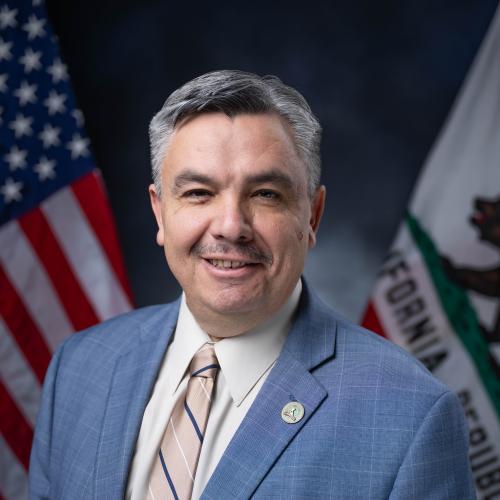
Juan Carrillo, a Democrat, represents the 39th Assembly District, which covers parts of Los Angeles and San Bernardino counties, in the California State Assembly.[1]
His official website says he was first elected in November 2022, re-elected in November 2024, and previously served on the Palmdale City Council after 15 years as a city planner, 10 of them with the City of Palmdale.[2]According to the same page, he was born and raised in Guadalajara, Jalisco, Mexico, immigrated to Los Angeles at 15, holds degrees from College of the Desert, Cal Poly Pomona and Cal State Northridge, and lives in east Palmdale.[2]
Their recorded votes on bills that divided the chamber (unanimous votes left out), grouped by topic. A bill can sit under more than one topic. "With" and "against" compare each vote with how most Democrats voted. How topics are assigned
›Jobs & cost of living441 with · 0 against441 votes
(1) Existing law creates the Metropolitan Transportation Commission as a local area planning agency for the 9-county San Francisco Bay area with comprehensive regional transportation planning and other related responsibilities. Existing law creates various transit districts located in the San Francisco Bay area, with specified powers and duties relating to providing public transit services.
The Mills-Deddeh Transit Development Act establishes the San Diego Metropolitan Transit Development Board, also known as the San Diego Metropolitan Transit System (MTS), governed by a 15-member board with specified powers and duties related to the operation of public transit services in the southern portion of the County of San Diego.
Existing law declares every contract by which anyone is restrained from engaging in a lawful profession, trade, or business of any kind to be void, except as expressly provided. Existing law provides for a system of labor standards enforcement administered by the Labor Commissioner.
Existing law, until January 1, 2031, authorizes a city or county prosecuting attorney or county probation department to create a diversion or deferred entry of judgment program for persons who commit a theft offense or repeat theft offenses. Existing law requires the prosecuting attorney in a participating county to either refer the case to the county probation department to conduct a prefiling investigation report and determine the appropriateness of program placement or, if the prosecuting attorney’s office operates the program, determine if the case is appropriate for referral.
Existing law prohibits a public agency, which includes the state, a city, a county, a city and county, or any agency or political subdivision of the state, a city, a county, or a city and county, including, but not limited to, a law enforcement agency, from selling, sharing, or transferring automated license plate recognition (ALPR) information, except to another public agency, and only as otherwise permitted by law. Existing law defines ALPR information as information or data collected through the use of an ALPR system.
Existing law authorizes a judge in the superior court in which a misdemeanor is being prosecuted to offer misdemeanor diversion to a defendant. Existing law, upon successful completion of the terms, conditions, or programs ordered by the court, makes the arrest upon which the diversion was imposed deemed to have never occurred, except as specified relating to application to be a peace officer. This bill, the Safer Communities Through Opportunities Act, would authorize a court to exercise its discretion to grant pretrial diversion on a felony offense, subject to certain exceptions.
Existing law establishes various entities for specified purposes over specific geographic areas of the state, including the San Francisco Bay Restoration Authority and California Tahoe Regional Planning Agency, among others. This bill would establish the Monterey Bay Area Stewardship Authority, a regional entity with jurisdiction extending throughout the Monterey Bay region, as defined.
(1) Existing law creates the California Coastal Sanctuary and provides that it includes all state waters subject to tidal influence, except as provided. Existing law authorizes the State Lands Commission to enter into any lease for the extraction of oil or gas from state-owned tidelands and submerged lands in the California Coastal Sanctuary if the commission determines both that oil and gas deposits in the California Coastal Sanctuary are being drained by means of producing wells upon adjacent federal lands and that the lease is in the best interest of the state.
Jun 4, 2025 · Passed 42–26 · against most DemocratsOfficial record ↗
Existing law requires the Department of Toxic Substances Control, on or before January 1, 2029, to adopt regulations to enforce specified covered perfluoroalkyl and polyfluoroalkyl substances (PFAS) restrictions, which include prohibitions on the distribution, sale, or offering for sale of certain products that contain specified levels of PFAS. Existing law requires the department, on and after July 1, 2030, to enforce and ensure compliance with those provisions and regulations, as provided.
Existing law requires the Department of Toxic Substances Control, on or before January 1, 2029, to adopt regulations to enforce specified covered perfluoroalkyl and polyfluoroalkyl substances (PFAS) restrictions, which include prohibitions on the distribution, sale, or offering for sale of certain products that contain specified levels of PFAS. Existing law requires the department, on and after July 1, 2030, to enforce and ensure compliance with those provisions and regulations, as provided.
Under existing law, when a person, as a result of a mental disorder, is a danger to others or to themselves, or is gravely disabled, they may, upon probable cause, be taken into custody for a period of up to 72 hours for assessment, evaluation, and crisis intervention, or placement for evaluation and treatment, as specified. Existing law prohibits mental health personnel from instructing a peace officer to take a person to, or keep the person at, a jail, solely because of the unavailability of an acute bed.
(1) Under existing law, a licensed health care provider who is authorized by law to prescribe an opioid antagonist may issue standing orders for the distribution of an opioid antagonist to a person at risk of an opioid-related overdose or to a family member, friend, or other person in a position to assist a person at risk of an opioid-related overdose. Existing law exempts a health care provider who acts with reasonable care in issuing a prescription or order for an opioid antagonist from professional review, civil action, or criminal prosecution, under certain circumstances.
(1) Existing law requires a certificated employee of a school district of any type or class or of a county superintendent of schools, with an average daily attendance of 250 or more, who completes 2 consecutive years and is reelected for the next succeeding school year to a position requiring certification, to become and be classified as a permanent employee of the school district or county superintendent.
Existing law requires a parent, legal guardian, or driver who transports a child under 16 years of age on a highway in a motor vehicle to properly secure that child in an appropriate child passenger restraint system or safety belt, as specified. Existing law authorizes a child or ward under 8 years of age who is 4 feet 9 inches in height or taller to be properly restrained by a safety belt rather than by a child passenger restraint system.
(1) Under existing law, a caregiver who is 18 years of age or older and signs a caregiver’s authorization affidavit under penalty of perjury for a minor who lives in their home is authorized to enroll the minor in school and consent to school-related medical care on behalf of the minor.
Existing law authorizes a borrower to request forbearance on their residential mortgage loan for a period of 12 months if, among other things, the borrower affirms that they are experiencing financial hardship that prevents them from making timely payments on the loan due directly to the wildfire disaster described in the proclamation of a state of emergency issued by Governor Gavin Newsom on January 7, 2025, or the federally declared disaster, declared on January 8, 2025, related to the Eaton Wildfire, the Palisades Fire, and the Straight-line Winds.
Existing law establishes the Office of Land Use and Climate Innovation in the Governor’s office for the purpose of serving the Governor and the Governor’s cabinet as staff for long-range planning and research and constituting the comprehensive state planning agency. This bill would require the office, on or before July 1, 2028, to compile, standardize, maintain, and make publicly available through a consolidated online platform a core set of statewide standardized spatial planning datasets, as defined.
Existing law, the Davis-Stirling Common Interest Development Act, defines and regulates common interest developments, which include community apartment projects, condominium projects, planned developments, and stock cooperatives. Existing law imposes various requirements regarding the installation and use of an electric vehicle (EV) charging station placed in a common area or an exclusive use common area of a common interest development, including that the owner is required to provide a certificate of insurance that names the association as an additional insured party.
(1) Existing law creates the Metropolitan Transportation Commission as a local area planning agency for the 9-county San Francisco Bay area with comprehensive regional transportation planning and other related responsibilities. Existing law creates various transit districts located in the San Francisco Bay area, with specified powers and duties relating to providing public transit services.
The Mills-Deddeh Transit Development Act establishes the San Diego Metropolitan Transit Development Board, also known as the San Diego Metropolitan Transit System (MTS), governed by a 15-member board with specified powers and duties related to the operation of public transit services in the southern portion of the County of San Diego.
Existing law requires the Chair of the California Transportation Commission to create a Road Usage Charge Technical Advisory Committee in consultation with the Secretary of Transportation to guide the development and evaluation of a pilot program assessing the potential for mileage-based revenue collection as an alternative to the gas tax system. Existing law additionally requires the Transportation Agency, in consultation with the commission, to implement the pilot program, as specified. Existing law repeals these provisions on January 1, 2027.
Existing law prohibits a public agency, which includes the state, a city, a county, a city and county, or any agency or political subdivision of the state, a city, a county, or a city and county, including, but not limited to, a law enforcement agency, from selling, sharing, or transferring automated license plate recognition (ALPR) information, except to another public agency, and only as otherwise permitted by law. Existing law defines ALPR information as information or data collected through the use of an ALPR system.
Existing law, the California Consumer Privacy Act of 2018 (CCPA), grants a consumer various rights with respect to personal information that is collected or sold by a business, as defined, including the right to direct a business that sells or shares personal information about the consumer to third parties not to sell or share the consumer’s personal information, as specified.
Existing law requires the Department of Technology to conduct, in coordination with other interagency bodies as it deems appropriate, a comprehensive inventory of all high-risk automated decision systems (ADS) that have been proposed for use, development, or procurement by, or are being used, developed, or procured by, any state agency.
This measure would urge President Donald J. Trump to avoid raising the cost of living for American consumers by rescinding the tariffs that he has imposed since taking office in January 2025 and refunding the American people for the costs passed on to them by his tariffs. The measure would also urge the United States Congress to enact a joint resolution to rescind President Trump’s tariffs and to oppose all future unilateral and arbitrary tariff increases imposed by President Trump.
Under existing law, there are programs providing assistance for, among other things, emergency housing, multifamily housing, farmworker housing, home ownership for very low and low-income households, and downpayment assistance for first-time home buyers.
Existing law establishes the Governor’s Office of Business and Economic Development (”GO-Biz”) to, among other duties, serve the Governor as the lead entity for economic strategy and the marketing of California on issues relating to business development, private sector investment, and economic growth. Existing law requires the Transportation Agency to establish a freight advisory committee to, among other things, participate in the development of the state freight plan.
Voted against most of their party on 3 of 819 party-divided votes on file.
Juveniles: detention.
What it does: (1) Existing law requires a court to determine whether a minor in custody will be released from, or detained in, custody, considering, among other things, whether it is a matter of immediate and urgent necessity for t…
Voted no · most Democrats voted yes · Democrats 24–16, Republicans 0–17
Environmental justice: Department of Justice: Bureau of Environmental Justice: community air monitoring.
What it does: Existing provisions of the California Constitution make the Attorney General, subject to the powers and duties of the Governor, the chief law officer of the state. Under existing law, the Attorney General may maintain…
Voted no · most Democrats voted yes · Democrats 54–1, Republicans 1–18
Coastal resources: California Coastal Sanctuary: tidelands and submerged lands: oil and gas development.
What it does: (1) Existing law creates the California Coastal Sanctuary and provides that it includes all state waters subject to tidal influence, except as provided. Existing law authorizes the State Lands Commission to enter into…
Voted no · most Democrats voted yes · Democrats 42–8, Republicans 0–18
Substantive votes concern legislation or nominations; procedural votes concern how the chamber considers them. A Yes vote applies to the motion shown, which may not be final passage.
AB 1128 · CA ASSEMBLY
Mobilehome parks: rent caps: City of Torrance.
Not votingNO VOTE
Motion: AB 1128 Muratsuchi Concurrence in Senate Amendments
Existing law, the Mobilehome Residency Law, prescribes various terms and conditions of tenancies in mobilehome parks. The law defines “mobilehome park” for these purposes to mean an area of land where 2 or more mobilehome sites are rented, or held out for rent, to accommodate mobilehomes used for human habitation. The law caps the amount by which management of a qualified mobilehome park may increase the gross rental rate for a tenancy over the course of any 12-month period.
Motion: AB 113 GABRIEL Concurrence in Senate Amendments
The Budget Act of 2026 made appropriations for the support of state government for the 2026–27 fiscal year. This bill would amend that budget act by amending, adding, and repealing items of appropriation and making other changes. This bill would declare that it is to take effect immediately as a Budget Bill. This bill would declare that it makes an appropriation for the usual current expenses of the state, and shall go into immediate effect. This bill would declare that it is to take effect immediately as an urgency statute.
Williamson Act contracts: cancellation fees: photovoltaic solar facilities.
YesVOTED
Motion: AB 1156 WICKS Concurrence in Senate Amendments
The California Land Conservation Act of 1965 (act), otherwise known as the Williamson Act, authorizes a city or county to contract with a landowner to limit the use of agricultural land to agricultural use if the land is located in an agricultural preserve designated by the city or county, as specified. Existing law authorizes the county or city to cancel a contract under certain circumstances and conditions.
Motion: AB 1159 Addis Concurrence in Senate Amendments
Existing law, the K–12 Pupil Online Personal Information Protection Act (KOPIPA), generally protects the personal information of a student enrolled in a K–12 course of instruction, defined as a “pupil,” by prescribing requirements and prohibitions applicable to an operator of an internet website, online service, online application, or mobile application with actual knowledge that the site, service, or application is used primarily for K–12 school purposes and was designed and marketed for K–12 school purposes.
Real property tax: welfare exemption: moderate-income housing.
Not votingNO VOTE
Motion: AB 1294 Haney Concurrence in Senate Amendments
Existing property tax law, pursuant to constitutional authorization, provides for a “welfare exemption” for property used exclusively for religious, hospital, scientific, or charitable purposes and that is owned or operated by certain types of nonprofit entities, if certain qualifying criteria are met.
Motion: AB 1307 Ávila Farías Concurrence in Senate Amendments
Existing law, the Licensed Dentists from Mexico Pilot Program, requires the Dental Board of California to issue 3-year nonrenewable permits to practice dentistry to dentists from Mexico who meet specified criteria. This bill would repeal those provisions and replace them with a new Licensed Dentists from Mexico Pilot Program. Under that new program, the bill would require the board to issue a 3-year nonrenewable license to practice dentistry to an applicant who meets specified criteria, and require participants in the program to comply with specified requirements.
Motion: AB 1331 Elhawary Concurrence in Senate Amendments
Existing law establishes the Division of Labor Standards Enforcement within the Department of Industrial Relations. Existing law authorizes the division, which is headed by the Labor Commissioner, to enforce the Labor Code and all labor laws of the state the enforcement of which is not specifically vested in any other officer, board, or commission. This bill would limit the use of workplace surveillance tools, as defined, by employers, including by prohibiting an employer from monitoring or surveilling employees in a bathroom located in the workplace, except as specified.
Motion: AB 1349 BRYAN Concurrence in Senate Amendments Move The Previous Question By AGUIAR-CURRY
Existing law provides comprehensive regulation of ticket sellers, defined as a person who, for compensation, commission, or otherwise, sells admission tickets to a sporting, musical, theater, or any other entertainment event. In this regard, existing law, among other things, prohibits specified ticket selling practices and imposes certain recordkeeping and disclosure requirements. If an event is canceled, existing law requires that the ticket price be fully refunded to the consumer whether by an original seller, event presenter, ticket reseller, or ticket resale marketplace, as specified.
Motion: AB 1609 Zbur Concurrence in Senate Amendments
Existing law prohibits a person from using a bot, as defined, to mislead another person about the bot’s artificial identity to incentivize the purchase or sale of goods or services, among other things. Existing law requires an operator of a companion chatbot, as defined, to provide a disclosure regarding the companion chatbot’s artificial identity if a reasonable person interacting with the companion chatbot would be misled to believe that the person is interacting with a human.
Motion: AB 1642 HARABEDIAN Concurrence in Senate Amendments
Existing law establishes the Department of Toxic Substances Control, which regulates the handling and management of hazardous waste and hazardous materials, and establishes the Office of Environmental Health Hazard Assessment and the State Air Resources Board. Existing federal law sets action levels for lead in dust and emission standards for asbestos, and existing state law sets workplace standards for asbestos. Existing law authorizes local health officers to take specified actions to protect public health and establishes procedures for the remediation of certain contaminated properties.