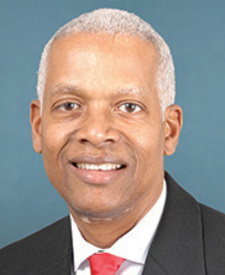
Hank Johnson is the incumbent U.S. Representative for Georgia's 4th Congressional District, serving since 2007 and elected to his 10th term in 2024. A lawyer who practiced in Decatur and served as a magistrate judge and DeKalb County Commissioner before Congress, he sits on the House Judiciary Committee. He is seeking re-election.[1][2]
Johnson was born in Washington, D.C.[1][2]He graduated from Clark College (now Clark Atlanta University) in 1976 with a B.A. in political science and from Texas Southern University's Thurgood Marshall School of Law in 1979.[1][2]According to his official biography, he practiced law for 27 years in Decatur, Georgia, specializing in criminal defense, civil rights, and personal injury law (Ballotpedia says more than 25 years).[2][1]
Johnson served as a magistrate judge for 12 years, according to his official biography.[2]He also served as a DeKalb County Commissioner, for five years according to his official biography (Ballotpedia lists 2000 to 2005), including as chair of the county's budget committee from 2002 to 2005.[1][2]In 2006 he challenged Rep. Cynthia McKinney in the Democratic primary, forced a runoff, and won the August 8, 2006 runoff with about 59% of the vote; he took office in January 2007.[3][2]
In Congress, Johnson serves on the House Judiciary Committee, where he is ranking member of the Subcommittee on Courts, Intellectual Property, Artificial Intelligence, and the Internet, and on the Transportation and Infrastructure Committee (2025-2026).[2][1]According to his official biography, in 2010 he was a member of the House prosecution team in the impeachment trial of Judge G. Thomas Porteous Jr., and he introduced the FAIR Act on forced arbitration, which passed the House twice, and the Stop Militarizing Law Enforcement Act.[2]He and his wife, DeKalb County Commissioner Mereda Davis Johnson, have two adult children, according to his official biography.[2]
Their recorded votes on bills that divided the chamber (unanimous votes left out), grouped by topic. A bill can sit under more than one topic. "With" and "against" compare each vote with how most Democrats voted. How topics are assigned
›Jobs & cost of living131 with · 7 against138 votes
Secure America Act This act provides $70 billion in funding to the Department of Homeland Security (DHS), U.S. Customs and Border Protection (CBP), and U.S. Immigration and Customs Enforcement (ICE) through FY2029 for immigration enforcement, border security, and related activities.
This concurrent resolution establishes the congressional budget for the federal government for FY2025, sets forth budgetary levels for FY2026-FY2034, and provides reconciliation instructions for legislation that increases or decreases the deficit and increases the statutory debt limit by specified amounts.
Feb 25, 2025 · Passed 217–215 · with most DemocratsOfficial record ↗
This concurrent resolution establishes the congressional budget for the federal government for FY2026, sets forth budgetary levels for FY2027-FY2035, and provides reconciliation instructions for legislation that increases the deficit.
Apr 29, 2026 · Passed 215–211 · with most DemocratsOfficial record ↗
This concurrent resolution directs the President to remove U.S. Armed Forces from Venezuela unless a declaration of war or authorization to use military force for such purpose has been enacted.
Jan 22, 2026 · Failed 215–215 · with most DemocratsOfficial record ↗
This concurrent resolution directs the President to remove U.S. Armed Forces from hostilities against Iran unless explicitly authorized by a declaration of war or a congressional authorization for use of military force against Iran.
Apr 16, 2026 · Failed 213–214 · with most DemocratsOfficial record ↗
National Defense Authorization Act for Fiscal Year 2026 This bill sets forth policies and authorities for FY2026 for Department of Defense (DOD) programs and activities, military construction, and the national security programs of the Department of Energy (DOE).
Dec 10, 2025 · Failed 209–216 · with most DemocratsOfficial record ↗
This joint resolution nullifies the rule submitted by the Bureau of Land Management (BLM) on November 20, 2024, which amended the 2015 resource management plan (RMP) for the Buffalo Field Office in Wyoming to make no federal coal available for future leasing.
Nov 18, 2025 · Passed 214–212 · with most DemocratsOfficial record ↗
This joint resolution removes the requirements for sources of persistent and bioaccumulative hazardous air pollutants to comply with certain major source emissions standards when those sources reclassify as area sources (which have less stringent standards).
May 22, 2025 · Passed 216–212 · with most DemocratsOfficial record ↗
Secure America Act This act provides $70 billion in funding to the Department of Homeland Security (DHS), U.S. Customs and Border Protection (CBP), and U.S. Immigration and Customs Enforcement (ICE) through FY2029 for immigration enforcement, border security, and related activities.
Safeguard American Voter Eligibility Act or the SAVE America Act This bill requires individuals to provide documentary proof of U.S. citizenship when registering to vote, and requires photo identification to vote, in federal elections.
Feb 11, 2026 · Failed 214–217 · with most DemocratsOfficial record ↗
District of Columbia Judicial Nominations Reform Act This bill terminates the District of Columbia (DC) Judicial Nomination Commission. Currently, the commission recommends to the President nominees for judges for DC's Superior Court and Court of Appeals, who must then be confirmed by the Senate.
Sep 17, 2025 · Passed 218–211 · with most DemocratsOfficial record ↗
Pregnant Students' Rights Act This bill requires each institution of higher education (IHE) that participates in federal student aid programs to provide certain information to prospective and enrolled students on the rights and resources for pregnant students to carry a baby to term or students who may become pregnant while enrolled at the IHE to carry a baby to term.
Jan 22, 2026 · Passed 217–211 · with most DemocratsOfficial record ↗
Protection of Women and Girls in Sports Act of 2025 This bill generally prohibits school athletic programs from allowing individuals whose biological sex at birth was male to participate in programs that are for women or girls.
Jan 14, 2025 · Passed 218–206 · with most DemocratsOfficial record ↗
No Funds for Repeat Child Care Violations Act of 2026 This bill subjects states to additional sanctions for improperly using funds under the Child Care and Development Block Grant program.
Anti-CBDC Surveillance State Act This bill prohibits a Federal Reserve bank from offering products or services directly to an individual, maintaining an account on behalf of an individual, or issuing a central bank digital currency (i.
Jul 17, 2025 · Passed 219–210 · with most DemocratsOfficial record ↗
Undersea Cable Protection Act of 2025 This bill prohibits the Department of Commerce from enforcing certain permit requirements for activities related to undersea fiber optic cables in national marine sanctuaries.
Feb 11, 2026 · Passed 218–212 · with most DemocratsOfficial record ↗
This resolution provides for the consideration of the bill (H.R. 8035) to amend the FISA Amendments Act of 2008 to extend the authorities of title VII of the Foreign Intelligence Surveillance Act of 1978 through October 20, 2027, and for other purposes.
Apr 17, 2026 · Failed 200–220 · with most DemocratsOfficial record ↗
SUPPORT for Patients and Communities Reauthorization Act of 2025 This act reauthorizes and revises programs and activities relating to addressing substance use disorders, overdoses, and mental health.
This act reduces taxes, reduces or increases spending for various federal programs, increases the statutory debt limit, and otherwise addresses agencies and programs throughout the federal government.
May 22, 2025 · Passed 215–214 · with most DemocratsOfficial record ↗
Allows employer groups to form association health plans, changes treatment of stop-loss insurance and health reimbursement arrangements, adds oversight of pharmacy benefit managers, and funds cost-sharing reduction payments from 2027.
Dec 17, 2025 · Passed 216–211 · with most DemocratsOfficial record ↗
This joint resolution revokes the authorization granted to the California Air Resources Board (CARB) to amend its Ocean-Going Vessels At-Berth Regulation.
Sep 15, 2026 · Passed 216–211 · with most DemocratsOfficial record ↗
This joint resolution revokes the partial authorization granted to the California Air Resources Board (CARB) to amend its Commercial Harbor Craft regulation.
Sep 16, 2026 · Passed 214–208 · with most DemocratsOfficial record ↗
This joint resolution allows off-road vehicles to be used in certain areas of the Glen Canyon National Recreation Area, which is in northern Arizona and southeastern Utah and contains Lake Powell.
Apr 29, 2025 · Passed 219–205 · with most DemocratsOfficial record ↗
Affordable Housing Over Mandating Efficiency Standards Act or the Affordable HOMES Act This bill rescinds Department of Energy (DOE) energy efficiency regulations applicable to manufactured housing and eliminates DOE’s authority to issue similar regulations.
Tribal Trust Land Homeownership Act of 2025 This act sets forth requirements for the processing of a proposed residential leasehold mortgage, business leasehold mortgage, land mortgage, or right-of-way document by the Bureau of Indian Affairs (BIA).
Housing for the 21st Century Act This bill revises federal housing programs, including by expanding available financing for affordable housing and providing grants for planning and community development activities.
Voted against most of their party on 3 of 463 party-divided votes on file.
Expressing support for law enforcement officers
What it does: This concurrent resolution expresses support for law enforcement officers. It also appreciates the contributions and recognizes the sacrifices of law enforcement officers.
Voted yes · most Democrats voted no · Democrats 29–173, Republicans 213–0
Amendment (Luna) to H.R. 7567 — Farm, Food, and National Security Act of 2026
A yes vote adopted an amendment (Luna) striking the bill’s sections on pesticide label uniformity, state authority over pesticides, and lawful use of authorized pesticides. (AI-written)
What it does: Farm, Food, and National Security Act of 2026 This bill (commonly known as the farm bill) reauthorizes through FY2031 and modifies Department of Agriculture programs that address commodity support, conservation, trade…
Voted no · most Democrats voted yes · Democrats 207–6, Republicans 73–135
DHS Restrictions on Confucius Institutes and Chinese Entities of Concern Act
What it does: DHS Restrictions on Confucius Institutes and Chinese Entities of Concern Act This bill restricts funding to an institution of higher education (IHE) that has a relationship with a Confucius Institute, Thousand Talents…
Voted yes · most Democrats voted no · Democrats 55–153, Republicans 210–0
Substantive votes concern legislation or nominations; procedural votes concern how the chamber considers them. A Yes vote applies to the motion shown, which may not be final passage.
S. 2403 · U.S. HOUSE
Retire through Ownership Act
YesVOTED
Motion: On Motion to Suspend the Rules and Pass
A yes vote suspended the House rules and passed S. 2403, the Retire through Ownership Act, under a fast-track procedure that requires a two-thirds majority. (AI-written)
Retire through Ownership Act This bill allows the fiduciary of an Employee Stock Ownership Plan (ESOP) to rely on a valuation provided by an independent valuation expert or business appraiser in determining the fair market value of the plan's securities if the securities are not traded on a national securities exchange (i.
Motion: On Motion to Suspend the Rules and Pass, as Amended
A yes vote suspended the House rules and passed H.R. 9497, the Water Resources Development Act, as amended, under a fast-track procedure that requires a two-thirds majority. (AI-written)
Water Resources Development Act of 2026 This bill authorizes and modifies certain water resource infrastructure projects and programs of the U.S. Army Corps of Engineers and makes related requirements.
Motion: On Motion to Suspend the Rules and Pass, as Amended
A yes vote suspended the House rules and passed H.R. 9340, the Ratepayer Protection Act, as amended, under a fast-track procedure that requires a two-thirds majority. (AI-written)
Ratepayer Protection Act The bill requires state utility regulators and nonregulated utilities to consider implementing a standard to hold certain large-load customers responsible for the costs associated with any generation, transmission, or distribution upgrade of electric service necessary to serve such customers.
Providing for congressional disapproval under chapter 8 of title 5, United States Code, of the rule issued by the Environmental Protection Agency relating to the “California State Nonroad Engine Pollution Control Standards; Commercial Harbor Craft Regulations; Notice of Decision”
NoVOTED
Motion: On Passage
This joint resolution revokes the partial authorization granted to the California Air Resources Board (CARB) to amend its Commercial Harbor Craft regulation.
Preventing Rip-offs and Obtaining Oversight of Funds Act or the PROOF Act This bill requires states to provide such information as the Department of Justice (DOJ) may require for the purpose of investigating or prosecuting alleged fraud committed with regard to certain federally funded programs.
National Fraud Enforcement Division Act of 2026 This bill provides statutory authority for the National Fraud Enforcement Division within the Department of Justice (DOJ). The division investigates and prosecutes fraud against taxpayer dollars and taxpayer-funded programs.
An Act to amend the Internal Revenue Code of 1986 to allow early childhood educators to take the educator expense deduction, and for other purposes
NoVOTED
Motion: On Motion to Concur in the Senate Amendments
A yes vote agreed to the Senate's amendments to H.R. 5334, which add Russia sanctions, higher duties and an Iran Sanctions Act extension to the early-childhood educator deduction, sending the bill to the president. (AI-written)
Lindsey O. Graham Sanctioning Russia and Iran Act of 2026 This bill imposes a variety of sanctions, tariffs, and prohibitions related to Russia, extends an Iran-related sanctions law, and expands a tax deduction for teacher expenses to include early childhood educators.
Directing the President, pursuant to section 5(c) of the War Powers Resolution, to remove United States Armed Forces from hostilities with Iran
YesVOTED
Motion: On Agreeing to the Resolution
This concurrent resolution directs the President to remove U.S. Armed Forces from hostilities against Iran unless explicitly authorized by a declaration of war or a congressional authorization for use of military force against Iran.
Providing for congressional disapproval under chapter 8 of title 5, United States Code, of the rule submitted by the Environmental Protection Agency relating to “California State Nonroad Engine Pollution Control Standards; Ocean-Going Vessels At-Berth; Notice of Decision”
NoVOTED
Motion: On Passage
This joint resolution revokes the authorization granted to the California Air Resources Board (CARB) to amend its Ocean-Going Vessels At-Berth Regulation.
Motion: On Motion to Suspend the Rules and Pass, as Amended
A yes vote suspended the House rules and passed H.R. 9500, the Tax Relief for Fraud Victims Act, as amended, under a fast-track procedure that requires a two-thirds majority. (AI-written)
Tax Relief for Fraud Victims Act This bill expands the federal tax deduction for personal casualty and theft losses by eliminating certain limits, including the requirement that such losses arise from certain disasters.