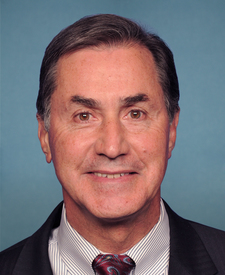
Gary Palmer is the incumbent Republican U.S. Representative for Alabama's 6th Congressional District, first elected in 2014. Before Congress he spent 24 years as president of the Alabama Policy Institute, a conservative think tank that grew out of the Alabama Family Alliance he started. In the House he has chaired the Republican Policy Committee and now chairs the Oversight and Investigations Subcommittee of the Energy and Commerce Committee; he is seeking re-election after winning the August 11, 2026 Republican primary.[1][2]
Palmer was born in Haleyville, Alabama, in 1954, and, according to his congressional website, grew up in the small town of Hackleburg in Northwest Alabama. He earned a bachelor's degree in operations management from the University of Alabama in 1977, where his website says he was a walk-on member of the football team under Coach Paul 'Bear' Bryant.[1][2]After graduating, he worked for two major international engineering and construction companies before his involvement with Focus on the Family led him to start the Alabama Family Alliance in 1989, which became the Alabama Policy Institute. He served as its president for 24 years, stepping down in 2014 to run for Congress, and also served on Gov. Robert Bentley's Alabama Commission on Improving State Government.[2][1][3]Wikipedia adds that Palmer helped found the State Policy Network, an umbrella organization of state-level think tanks, and served as its president.[3]
Palmer ran in 2014 for Alabama's 6th District seat, which 11-term Republican Rep. Spencer Bachus had held and was leaving after announcing his retirement. He finished second in a seven-candidate Republican primary on June 3, won the July 15 runoff over Paul DeMarco, 64% to 36%, and won the general election over Democrat Mark Lester with 76.2% of the vote.[1][3]He took office in the 114th Congress in January 2015 and has been re-elected since. House Republicans elected him chairman of the Republican Policy Committee for the 116th Congress, defeating David Schweikert, 130-63, and re-elected him unopposed for the 118th Congress; he chaired the committee from 2019 to 2025. He is listed as a member of the House Freedom Caucus.[1][3]For 2025-2026 his committee assignments are Energy and Commerce, where he chairs the Oversight and Investigations Subcommittee, and Oversight and Government Reform. He won the August 11, 2026 Republican primary with 85.7% of the vote over Case Dixon, after the original May primary results were voided.[1]
Their recorded votes on bills that divided the chamber (unanimous votes left out), grouped by topic. A bill can sit under more than one topic. "With" and "against" compare each vote with how most Republicans voted. How topics are assigned
›Jobs & cost of living125 with · 12 against137 votes
Secure America Act This act provides $70 billion in funding to the Department of Homeland Security (DHS), U.S. Customs and Border Protection (CBP), and U.S. Immigration and Customs Enforcement (ICE) through FY2029 for immigration enforcement, border security, and related activities.
Jun 9, 2026 · Passed 214–212 · with most RepublicansOfficial record ↗
This concurrent resolution establishes the congressional budget for the federal government for FY2025, sets forth budgetary levels for FY2026-FY2034, and provides reconciliation instructions for legislation that increases or decreases the deficit and increases the statutory debt limit by specified amounts.
Feb 25, 2025 · Passed 217–215 · with most RepublicansOfficial record ↗
This concurrent resolution establishes the congressional budget for the federal government for FY2026, sets forth budgetary levels for FY2027-FY2035, and provides reconciliation instructions for legislation that increases the deficit.
Apr 29, 2026 · Passed 215–211 · with most RepublicansOfficial record ↗
This concurrent resolution directs the President to remove U.S. Armed Forces from Venezuela unless a declaration of war or authorization to use military force for such purpose has been enacted.
Jan 22, 2026 · Failed 215–215 · with most RepublicansOfficial record ↗
This concurrent resolution directs the President to remove U.S. Armed Forces from hostilities against Iran unless explicitly authorized by a declaration of war or a congressional authorization for use of military force against Iran.
Apr 16, 2026 · Failed 213–214 · with most RepublicansOfficial record ↗
National Defense Authorization Act for Fiscal Year 2026 This bill sets forth policies and authorities for FY2026 for Department of Defense (DOD) programs and activities, military construction, and the national security programs of the Department of Energy (DOE).
Dec 10, 2025 · Failed 209–216 · with most RepublicansOfficial record ↗
This joint resolution nullifies the rule submitted by the Bureau of Land Management (BLM) on November 20, 2024, which amended the 2015 resource management plan (RMP) for the Buffalo Field Office in Wyoming to make no federal coal available for future leasing.
Nov 18, 2025 · Passed 214–212 · with most RepublicansOfficial record ↗
This joint resolution removes the requirements for sources of persistent and bioaccumulative hazardous air pollutants to comply with certain major source emissions standards when those sources reclassify as area sources (which have less stringent standards).
May 22, 2025 · Passed 216–212 · with most RepublicansOfficial record ↗
Secure America Act This act provides $70 billion in funding to the Department of Homeland Security (DHS), U.S. Customs and Border Protection (CBP), and U.S. Immigration and Customs Enforcement (ICE) through FY2029 for immigration enforcement, border security, and related activities.
Jun 9, 2026 · Passed 214–212 · with most RepublicansOfficial record ↗
Safeguard American Voter Eligibility Act or the SAVE America Act This bill requires individuals to provide documentary proof of U.S. citizenship when registering to vote, and requires photo identification to vote, in federal elections.
Feb 11, 2026 · Failed 214–217 · with most RepublicansOfficial record ↗
District of Columbia Judicial Nominations Reform Act This bill terminates the District of Columbia (DC) Judicial Nomination Commission. Currently, the commission recommends to the President nominees for judges for DC's Superior Court and Court of Appeals, who must then be confirmed by the Senate.
Sep 17, 2025 · Passed 218–211 · with most RepublicansOfficial record ↗
Pregnant Students' Rights Act This bill requires each institution of higher education (IHE) that participates in federal student aid programs to provide certain information to prospective and enrolled students on the rights and resources for pregnant students to carry a baby to term or students who may become pregnant while enrolled at the IHE to carry a baby to term.
Jan 22, 2026 · Passed 217–211 · with most RepublicansOfficial record ↗
Protection of Women and Girls in Sports Act of 2025 This bill generally prohibits school athletic programs from allowing individuals whose biological sex at birth was male to participate in programs that are for women or girls.
Jan 14, 2025 · Passed 218–206 · with most RepublicansOfficial record ↗
No Funds for Repeat Child Care Violations Act of 2026 This bill subjects states to additional sanctions for improperly using funds under the Child Care and Development Block Grant program.
Jun 3, 2026 · Passed 217–207 · with most RepublicansOfficial record ↗
Anti-CBDC Surveillance State Act This bill prohibits a Federal Reserve bank from offering products or services directly to an individual, maintaining an account on behalf of an individual, or issuing a central bank digital currency (i.
Jul 17, 2025 · Passed 219–210 · with most RepublicansOfficial record ↗
Undersea Cable Protection Act of 2025 This bill prohibits the Department of Commerce from enforcing certain permit requirements for activities related to undersea fiber optic cables in national marine sanctuaries.
Feb 11, 2026 · Passed 218–212 · with most RepublicansOfficial record ↗
This resolution provides for the consideration of the bill (H.R. 8035) to amend the FISA Amendments Act of 2008 to extend the authorities of title VII of the Foreign Intelligence Surveillance Act of 1978 through October 20, 2027, and for other purposes.
Apr 17, 2026 · Failed 200–220 · with most RepublicansOfficial record ↗
SUPPORT for Patients and Communities Reauthorization Act of 2025 This act reauthorizes and revises programs and activities relating to addressing substance use disorders, overdoses, and mental health.
Jun 4, 2025 · Failed 213–213 · with most RepublicansOfficial record ↗
This act reduces taxes, reduces or increases spending for various federal programs, increases the statutory debt limit, and otherwise addresses agencies and programs throughout the federal government.
May 22, 2025 · Passed 215–214 · with most RepublicansOfficial record ↗
Supporting Pregnant and Parenting Women and Families Act This bill provides statutory authority for states to use Temporary Assistance for Needy Families (TANF) funds for pregnancy centers that (1) support protecting the life of the mother and the unborn child; and (2) offer resources and services to mothers, fathers, and families, including relationship counseling, prenatal and pregnancy education, pregnancy testing, diapers, baby clothes, and material supports.
Jan 21, 2026 · Passed 215–209 · with most RepublicansOfficial record ↗
This joint resolution revokes the authorization granted to the California Air Resources Board (CARB) to amend its Ocean-Going Vessels At-Berth Regulation.
Sep 15, 2026 · Passed 216–211 · with most RepublicansOfficial record ↗
This joint resolution revokes the partial authorization granted to the California Air Resources Board (CARB) to amend its Commercial Harbor Craft regulation.
Sep 16, 2026 · Passed 214–208 · with most RepublicansOfficial record ↗
This joint resolution allows off-road vehicles to be used in certain areas of the Glen Canyon National Recreation Area, which is in northern Arizona and southeastern Utah and contains Lake Powell.
Apr 29, 2025 · Passed 219–205 · with most RepublicansOfficial record ↗
Affordable Housing Over Mandating Efficiency Standards Act or the Affordable HOMES Act This bill rescinds Department of Energy (DOE) energy efficiency regulations applicable to manufactured housing and eliminates DOE’s authority to issue similar regulations.
Jan 9, 2026 · Passed 263–147 · with most RepublicansOfficial record ↗
Tribal Trust Land Homeownership Act of 2025 This act sets forth requirements for the processing of a proposed residential leasehold mortgage, business leasehold mortgage, land mortgage, or right-of-way document by the Bureau of Indian Affairs (BIA).
Mar 4, 2026 · Passed 384–40 · with most RepublicansOfficial record ↗
Housing for the 21st Century Act This bill revises federal housing programs, including by expanding available financing for affordable housing and providing grants for planning and community development activities.
Jun 23, 2026 · Passed 358–32 · with most RepublicansOfficial record ↗
Voted against most of their party on 7 of 466 party-divided votes on file.
Most often on: Climate & energy (5), Jobs & cost of living (4), Foreign affairs & defense (1)
Amendment (Boebert) to H.R. 8800 — National Defense Authorization Act for Fiscal Year 2027
A yes vote supported an H.R. 8800 amendment that strikes section 518, a pilot program using voice-based risk assessment technology to identify servicemembers for drug testing. (AI-written)
What it does: National Defense Authorization Act for Fiscal Year 2027 This bill sets forth policies and authorities for FY2027 for Department of Defense (DOD) programs, activities, and military construction as well as the national…
Voted yes · most Republicans voted no · Democrats 175–37, Republicans 90–123
What it does: Nationwide Consumer and Fuel Retailer Choice Act of 2025 This bill amends the Clean Air Act to address the limitations on Reid Vapor Pressure (a measure of gasoline's volatility) that are placed on gasoline during the…
Voted no · most Republicans voted yes · Democrats 95–113, Republicans 122–90
What it does: Rotorcraft Operations Transparency and Oversight Reform Act or the ROTOR Act This bill addresses aviation safety by increasing requirements for aircraft tracking and communication using Automatic Dependent Surveillanc…
Voted yes · most Republicans voted no · Democrats 187–1, Republicans 77–131
Amendment (Perry) to H.R. 4553 — Energy and Water Development and Related Agencies Appropriations Act, 2026
A yes vote would have adopted Amendment 31 to the Energy and Water appropriations bill, which cuts $2,063,381 from the Great Lakes Authority and credits it to the spending reduction account. (AI-written)
What it does: Energy and Water Development and Related Agencies Appropriations Act, 2026 This bill provides FY2026 appropriations for U.S. Army Corps of Engineers civil works projects, the Department of the Interior's Bureau of Rec…
Voted no · most Republicans voted yes · Democrats 0–207, Republicans 120–94
Amendment (Perry) to H.R. 4553 — Energy and Water Development and Related Agencies Appropriations Act, 2026
A yes vote would have adopted Amendment 30 to the Energy and Water appropriations bill, which cuts $16,003,526 from the Southeast Crescent Regional Commission and credits it to the spending reduction account. (AI-written)
What it does: Energy and Water Development and Related Agencies Appropriations Act, 2026 This bill provides FY2026 appropriations for U.S. Army Corps of Engineers civil works projects, the Department of the Interior's Bureau of Rec…
Voted no · most Republicans voted yes · Democrats 0–211, Republicans 120–95
Substantive votes concern legislation or nominations; procedural votes concern how the chamber considers them. A Yes vote applies to the motion shown, which may not be final passage.
S. 2403 · U.S. HOUSE
Retire through Ownership Act
YesVOTED
Motion: On Motion to Suspend the Rules and Pass
A yes vote suspended the House rules and passed S. 2403, the Retire through Ownership Act, under a fast-track procedure that requires a two-thirds majority. (AI-written)
Retire through Ownership Act This bill allows the fiduciary of an Employee Stock Ownership Plan (ESOP) to rely on a valuation provided by an independent valuation expert or business appraiser in determining the fair market value of the plan's securities if the securities are not traded on a national securities exchange (i.
Motion: On Motion to Suspend the Rules and Pass, as Amended
A yes vote suspended the House rules and passed H.R. 9497, the Water Resources Development Act, as amended, under a fast-track procedure that requires a two-thirds majority. (AI-written)
Water Resources Development Act of 2026 This bill authorizes and modifies certain water resource infrastructure projects and programs of the U.S. Army Corps of Engineers and makes related requirements.
Motion: On Motion to Suspend the Rules and Pass, as Amended
A yes vote suspended the House rules and passed H.R. 9340, the Ratepayer Protection Act, as amended, under a fast-track procedure that requires a two-thirds majority. (AI-written)
Ratepayer Protection Act The bill requires state utility regulators and nonregulated utilities to consider implementing a standard to hold certain large-load customers responsible for the costs associated with any generation, transmission, or distribution upgrade of electric service necessary to serve such customers.
Providing for congressional disapproval under chapter 8 of title 5, United States Code, of the rule issued by the Environmental Protection Agency relating to the “California State Nonroad Engine Pollution Control Standards; Commercial Harbor Craft Regulations; Notice of Decision”
YesVOTED
Motion: On Passage
This joint resolution revokes the partial authorization granted to the California Air Resources Board (CARB) to amend its Commercial Harbor Craft regulation.
Preventing Rip-offs and Obtaining Oversight of Funds Act or the PROOF Act This bill requires states to provide such information as the Department of Justice (DOJ) may require for the purpose of investigating or prosecuting alleged fraud committed with regard to certain federally funded programs.
National Fraud Enforcement Division Act of 2026 This bill provides statutory authority for the National Fraud Enforcement Division within the Department of Justice (DOJ). The division investigates and prosecutes fraud against taxpayer dollars and taxpayer-funded programs.
An Act to amend the Internal Revenue Code of 1986 to allow early childhood educators to take the educator expense deduction, and for other purposes
YesVOTED
Motion: On Motion to Concur in the Senate Amendments
A yes vote agreed to the Senate's amendments to H.R. 5334, which add Russia sanctions, higher duties and an Iran Sanctions Act extension to the early-childhood educator deduction, sending the bill to the president. (AI-written)
Lindsey O. Graham Sanctioning Russia and Iran Act of 2026 This bill imposes a variety of sanctions, tariffs, and prohibitions related to Russia, extends an Iran-related sanctions law, and expands a tax deduction for teacher expenses to include early childhood educators.
Directing the President, pursuant to section 5(c) of the War Powers Resolution, to remove United States Armed Forces from hostilities with Iran
NoVOTED
Motion: On Agreeing to the Resolution
This concurrent resolution directs the President to remove U.S. Armed Forces from hostilities against Iran unless explicitly authorized by a declaration of war or a congressional authorization for use of military force against Iran.
Providing for congressional disapproval under chapter 8 of title 5, United States Code, of the rule submitted by the Environmental Protection Agency relating to “California State Nonroad Engine Pollution Control Standards; Ocean-Going Vessels At-Berth; Notice of Decision”
YesVOTED
Motion: On Passage
This joint resolution revokes the authorization granted to the California Air Resources Board (CARB) to amend its Ocean-Going Vessels At-Berth Regulation.
Motion: On Motion to Suspend the Rules and Pass, as Amended
A yes vote suspended the House rules and passed H.R. 9500, the Tax Relief for Fraud Victims Act, as amended, under a fast-track procedure that requires a two-thirds majority. (AI-written)
Tax Relief for Fraud Victims Act This bill expands the federal tax deduction for personal casualty and theft losses by eliminating certain limits, including the requirement that such losses arise from certain disasters.