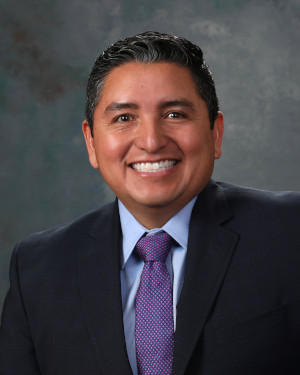
Derrick Lente is a Democratic state representative from New Mexico who has represented House District 65 since 2017 and is seeking re-election in the November 3, 2026 general election.[1][2]He is a business owner with a law degree from the University of New Mexico.[1]
Lente graduated from Bernalillo High School, earned a B.A. in intercultural communications and English from the University of New Mexico, and received his J.D. from the University of New Mexico School of Law.[1]His professional experience includes working as a small businessman and as a professor and visiting professor at several universities across the country.[1]
Their recorded votes on bills that divided the chamber (unanimous votes left out), grouped by topic. A bill can sit under more than one topic. "With" and "against" compare each vote with how most Democrats voted. How topics are assigned
Creates a trust fund, with no initial appropriation, for children born in New Mexico since Jan. 1, 2025, for education, housing, business or retirement if they remain lifelong residents, obtain a high school equivalency credential and take a financial literacy course; exempts payouts from state income tax; creates a planning task force.
As passed by the House, creates the Welcome Child and Family Wellness Leave Act: up to six weeks of paid family or medical leave within a 12-week limit per rolling 12 months, funded by employee and employer contributions, plus a $9,000 payment per child at birth or adoption.
Creates a 0.28 percent surtax on certain oil products when West Texas crude averages $55 or more a barrel, cuts the natural gas emergency school tax from 4 to 3.9 percent, and replaces the working families tax credit with an earned income tax credit.
Bars New Mexico public bodies from entering, extending or renewing agreements to detain people for federal civil immigration violations or to let local officers perform federal immigration functions, and requires existing such agreements to end at the earliest permitted date.
Lets law enforcement officers file petitions for extreme risk firearm protection orders based on information gathered in their official duties, and requires a person served with such an order to give up firearms immediately.
Requires courts to seal eviction case records once an eviction case is filed, lets landlords seek unsealing at least 15 days after winning possession, requires resealing within three years, limits access to parties, court staff and authorized attorneys, and says tenants need not disclose sealed records.
Requires electric utilities to file distribution system plans and beneficial electrification plans with the Public Regulation Commission, and lets them recover related costs; the committee amendment removes the proposed virtual power plant program.
Widens the types of entities that can receive grants from the geothermal projects development fund to include others in a competitive bidding process; the committee amendment removed the bill's $20 million appropriation.
Mar 6, 2025 · Passed 35–23 · against most DemocratsOfficial record ↗
Creates a trust fund, with no initial appropriation, for children born in New Mexico since Jan. 1, 2025, for education, housing, business or retirement if they remain lifelong residents, obtain a high school equivalency credential and take a financial literacy course; exempts payouts from state income tax; creates a planning task force.
As passed by the House, bans chemical, mechanical and prone restraint in public schools, limits seclusion to supervised confinement during imminent serious harm, allows physical restraint only when a student endangers self or others and lesser steps fail, and requires staff training and approved behavior plans.
Changes the Graduate Scholarship Act to require New Mexico residency and a bachelor's degree with a 3.0 GPA, prioritize students from groups underrepresented in graduate education, drop citizenship requirements, and cap awards at the full cost of tuition and fees instead of $7,200 a year.
As passed by the House, creates the Welcome Child and Family Wellness Leave Act: up to six weeks of paid family or medical leave within a 12-week limit per rolling 12 months, funded by employee and employer contributions, plus a $9,000 payment per child at birth or adoption.
Bars drug manufacturers and their agents or affiliates from restricting the acquisition or delivery of 340B discounted drugs to contract pharmacies of federally qualified health centers and look-alikes, interfering with those pharmacies dispensing, or requiring the centers to submit claims or utilization data.
Requires mobile home park owners to notify residents and the Mortgage Finance Authority of an offer they intend to accept, giving residents a chance to buy first if 51 percent signal intent within 75 days and secure financing within 90 more.
As passed by the House, adds source of income, including wages, Social Security and housing vouchers, as a protected category in the Human Rights Act, treats screening that omits some income sources as discrimination, and sends public and housing accommodation complaints to the Attorney General.
Bars local zoning rules, fees and taxes that treat child care homes differently from private residences, allows licensed child care centers by right in commercial, mixed-use and multifamily zones, and limits homeowner association rules and fees that apply only to child care homes.
Adds sex, gender identity, immigration status and national origin to the Motor Vehicle Code's definition of personal information, making them confidential.
Lets bicyclists treat red lights as stop signs and stop signs as yield signs: proceed through a red light after stopping if safe, and pass a stop sign without stopping if no one is approaching. Takes effect July 1, 2025.
Mar 17, 2025 · Passed 39–27 · against most DemocratsOfficial record ↗
Sets rules for automated license plate readers, barring sharing of data a user reasonably believes may be used for immigration enforcement or to investigate or prosecute protected health care activity, requiring use reporting, and allowing civil enforcement by the attorney general and district attorneys.
Adds sex, gender identity, immigration status and national origin to the Motor Vehicle Code's definition of personal information, making them confidential.
Sets rules for automated license plate readers, barring sharing of data a user reasonably believes may be used for immigration enforcement or to investigate or prosecute protected health care activity, requiring use reporting, and allowing civil enforcement by the attorney general and district attorneys.
Requires hotels, restaurants, theaters and other public accommodations to turn on closed captioning on TVs in public areas, with civil penalties of $1, $50 and $250 for first, second and third violations, and lets people harmed by violations sue.
Voted against most of their party on 6 of 71 party-divided votes on file.
Most often on: Rights & public safety (2), Climate & energy (2), Jobs & cost of living (1)
Legislative Compensation, Ca
What it does: Proposes a constitutional amendment setting legislators' pay at New Mexico's annual median household income, adjusted as that income changes, effective for members of the Fifty-Ninth Legislature if voters approve.
Voted no · most Democrats voted yes · Democrats 41–2, Republicans 0–24
What it does: Creates the State Fairgrounds District, a new governmental body with authority over planning, construction, redevelopment or demolition at the State Fairgrounds and nearby property, drawing on tax increment and redeve…
Voted no · most Democrats voted yes · Democrats 38–3, Republicans 1–23
What it does: Lets bicyclists treat red lights as stop signs and stop signs as yield signs: proceed through a red light after stopping if safe, and pass a stop sign without stopping if no one is approaching. Takes effect July 1, 2025.
Voted no · most Democrats voted yes · Democrats 38–2, Republicans 1–25
What it does: Renames the Department of Game and Fish the Department of Wildlife, changes how Game Commission members are chosen and removed, and raises most hunting and fishing license fees, including a $90 nonresident hunting lic…
Voted no · most Democrats voted yes · Democrats 40–3, Republicans 2–23
What it does: As passed by the House, renames the Juvenile Community Corrections Act the Juvenile Community Connections Act, extends short-term juvenile commitments from one year to 15 months and long-term from two years to 27 mont…
Voted no · most Democrats voted yes · Democrats 34–3, Republicans 0–21
Substantive votes concern legislation or nominations; procedural votes concern how the chamber considers them. A Yes vote applies to the motion shown, which may not be final passage.
SB 100 · NM HOUSE
Burglary Definition of Dwelling
YesVOTED
Motion: FINAL PASSAGE
Defines "structure" for burglary and aggravated burglary as a protected space enclosed enough to confine people or property and carrying an expectation of privacy, which may include a partially enclosed extension of a dwelling.
Appropriates about $11.9 million in FY27 to local governments, including Torrance County and Estancia, for revenue lost under the law barring local governments' new contracts with private immigration detention facilities, plus $9.7 million (FY26) and $24 million (FY27) to state agencies.
Requests the Legislative Finance Committee to study options for extending health insurance to all public higher education educators and graduate student employees, with results requested by October 1, 2026.
Invites state agencies, including Game and Fish, the State Land Office and Agriculture, to join an insect identification and education workshop run by UNM's Wild Friends Program and the Xerces Society, and share insect education materials.
Decouples corporate income tax from three 2025 federal provisions from 2027, creates credits for local news organizations, local news printers and physicians, adds a gross receipts deduction for affordable multifamily housing construction, extends the high-wage jobs credit, and funds a 1 percent pay raise.
Authorizes the State Fairgrounds District to issue revenue bonds with up to $92 million in net proceeds, repaid from state gross receipts and gaming tax revenue attributable to economic activity within the district.
Bars prior authorization and step therapy for drugs treating serious mental illness, bars repeat prior authorization for chronic maintenance drugs for three years, deems drug requests approved if not decided within three business days, and covers certain pharmacy benefit managers, starting Jan. 1, 2027.
Requires approved driver's education courses, starting Jan. 1, 2027, to include at least three hours on driving around vulnerable road users, such as pedestrians, roadside workers, people riding or leading animals and riders of less-protected vehicles, with the Transportation Department setting standards.
Proposes a constitutional amendment to remove the requirement that school elections be held at different times from partisan elections, for voters to decide.